
How to Search Cumberland County Civil Dockets
For Circuit Court and General Sessions civil cases, the Cumberland Online Court Records System is the main online channel. It serves Circuit Court and General Sessions civil cases. The public form takes a party name, year, case number, court type. It also asks civil or criminal case type. There is no first-screen filter for contract, divorce, real estate, tort, or garnishment. You have to open the matching case and read its detail instead. Before searching, check the caption on any pleading or notice. It should name the court. Chancery matters get no checkbox on the county form. Route those to the Clerk & Master.
- Select Circuit Court or General Sessions, then select Civil.
- Try the exact case number. If it is unavailable, enter the party name and year.
- Review matches carefully because names alone can return unrelated matters.
- Open the case detail and note party roles, filings, service, motions, settings, orders, and disposition.
- Confirm a critical entry or request a copy from the Cumberland County Circuit Court Clerk or Clerk & Master.
Find the Cumberland Civil Court First
Civil filings in Cumberland County are split across three courts. Match your case to the right court first. General Sessions takes civil claims within its limited authority. Circuit Court handles the wider trial stream, including the categories listed on its filing-fee schedule. Chancery Court is the main route for equity and domestic-relations matters. Ben Tollett serves as Clerk & Master at the Justice Center.
| Matter | First place to check | Why |
|---|---|---|
| Limited civil claim | General Sessions and Civil in TnCIS | The county portal exposes this combination. |
| Damages, tort, or contract debt | Circuit Court Clerk | The Circuit civil schedule covers this broader trial category. |
| Real estate or equity | Clerk & Master or Circuit Clerk | The correct court depends on the proceeding. |
| Domestic matter | Circuit or Chancery office | Custody and confidentiality must be confirmed. |
| Garnishment or bank levy | Clerk holding the judgment | Enforcement follows the underlying case. |
What a Cumberland Civil Docket Shows
Think of a Cumberland County court docket as an index. It also runs a history of events. It is not always a picture of every paper filed. The case detail can show the court, the case number, the filed date, the parties, and attorneys. It also lists a case description, the status, hearings, judgments, and payments. Read each entry by its label and its date together. One without the other can mislead you.
| Case number | The court-assigned identifier, entered exactly when known, such as the number printed on the pleading. |
|---|---|
| Parties | Plaintiff, defendant, petitioner, respondent, or another role shown by the record. |
| Filings | Complaint, answer, return of service, exhibit, or other filed item. |
| Motions and orders | A request by a party and the judge's separate ruling must not be confused. |
| Settings | Scheduled hearings, resets, or continuances that require current confirmation. |
| Disposition | Judgment, dismissal, transfer, or another closing event, subject to later activity. |
A Cumberland Complaint Is Not a Judgment
A complaint on the docket tells you one thing only. Someone placed a claim before a court. It does not prove the allegations. It does not establish liability or show that money is owed. A motion is just a request, while an order is what records actual judicial action. A proposed agreement stays a proposal. It takes the docket and a signed order to show an entered decree.
Read the event sequence: Compare the complaint, service entry, response, motion, hearing, signed order, and final disposition before describing the outcome.
Money judgments have moving parts. Principal, interest, court costs, attorney fees, execution, garnishment, and payment entries are all distinct lines. A short docket label is not enough to compute a current balance, so get the judgment and any later enforcement papers from the clerk.
Civil Case Types on the Cumberland Docket
Civil matters in Cumberland County split into several record trails. The portal's broad Civil checkbox will not tell you which trail your case sits on. Check the case caption and the paper that opened the case, or ask the clerk's office, before you rely on a docket search result.
- Damages, tort, contract, and debt actions in Circuit Court.
- General Sessions civil claims within that court's authority.
- Divorce, parenting, paternity, adoption, and other domestic matters assigned to Circuit or Chancery.
- Real-estate, equity, conservatorship, and related Chancery proceedings.
- Post-judgment garnishment, bank levy, contempt, and modification matters.
A public procedural entry can coexist with restricted content. Family, adoption, minor, medical, and financial details may stay sealed even when the docket itself is open. Search only the public case information, then ask the clerk what may be inspected in person.
Cumberland Civil Filing Fees Are Not Copy Fees
Filing fees and copy fees are different things. The official Circuit civil fee schedule effective January 1, 2026 sets what it costs to start or advance a case, and it warns that service fees are not included. Those amounts say nothing about ordinary copies of an existing court record.
| Listed filing | Amount | Scope note |
|---|---|---|
| Damages, torts, contract, debt | $377.50 | Service fees separate. |
| General Sessions appeal | $302.50 | Appeal bond also applies. |
| Divorce without children | $175.00 | Use the current clerk quote. |
| Divorce with children | $250.00 | Shown on the listed category line. |
| Garnishment | $42.00 | Underlying judgment records are separate. |
| Sheriff service | $52.00 | Not included in general filing totals. |
General Sessions civil filings carry a separate official fee sheet. Treat it as its own list, since Sessions amounts do not track the Circuit schedule. Ask the clerk for a current quote rather than carrying Circuit figures into a Sessions matter.
Cumberland Civil Docket Settings and Hearings
A civil setting could be many things. It might be a motion hearing, a status conference, a trial, or another event. The label alone will not always tell you what will happen. A continuance changes a setting without dismissing the case. The county portal helps you follow the event trail. But its own terms say online information is not the official clerk record and may change. So compare the docket date with the latest signed scheduling order or notice. Then confirm time, place, judge, and current status with the responsible office. Do this especially after a reset. The fuller Cumberland County court dates workflow lays out the available calendar channels.
The Cumberland Circuit Bench in Context
Circuit Judge William Ridley serves on the bench for the 13th Judicial District. That district covers Cumberland County plus six other counties. So his regional seat tells you nothing on its own. A judge's district-wide role never proves he set a hearing in one particular Cumberland County case. The docket itself is where that answer lives. Check the docket entry or ask the clerk before assuming an assignment.
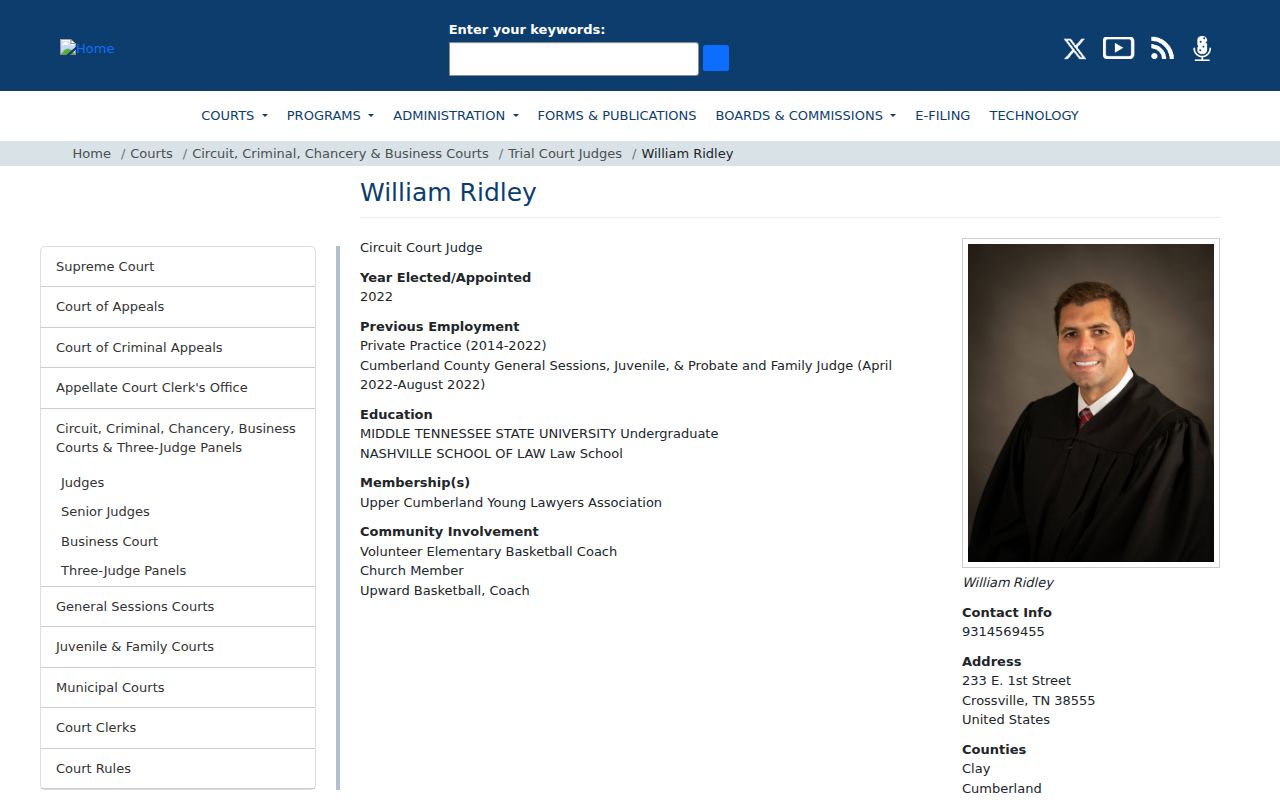
The profile is useful for one thing: mapping the trial-court structure. For the judge actually assigned to a Cumberland County civil matter, the docket and the clerk's office hold the answer.
Cumberland Civil Docket Access Rules
Public access to court records in Tennessee rests on Supreme Court Rule 34. The Tennessee Public Records Act adds its own presumption. Government records are open unless a statute says otherwise. Even so, a court file does not come to you; it must be requested from the clerk who holds it. Sealed documents, protected identifying details, and confidential family or juvenile material stay closed no matter how the docket search is run.
Key access rules: Tennessee Supreme Court Rule 34 addresses court-record access, while T.C.A. Title 10, Chapter 7, Part 5 supplies the public-record framework and exemptions.
A Cumberland County filing may be only partly restricted. Ask the clerk for the segregable non-exempt portion. And if an online docket search turns up no entry, say the record is not available through that channel, not that the case does not exist.
When the Cumberland Portal Does Not Answer
Sometimes the county form floods you with matches. It also hides some filters you might want. Slow down and work one court at a time. Enter the exact case number and year, and double-check the spelling of names. The statewide TnCIS multi-county search covers participating clerk offices. Availability varies, so treat it as a helper rather than the official Cumberland County file.
A phone call often settles what the portal cannot. For Circuit or General Sessions docket questions, call Circuit Court Clerk Jessica R. Burgess. Her office sits at 60 Justice Center Drive, Suite 300, Crossville, Tennessee 38555, (931) 484-5852. Chancery cases go to Clerk & Master Ben Tollett in Suite 226, at (931) 484-4731. Both offices keep weekday hours of 8:00 a.m. to 4:00 p.m. You can ask to inspect or copy court records. For older paper files, the clerk may need to pull from an archive, off-site storage, or microfilm.